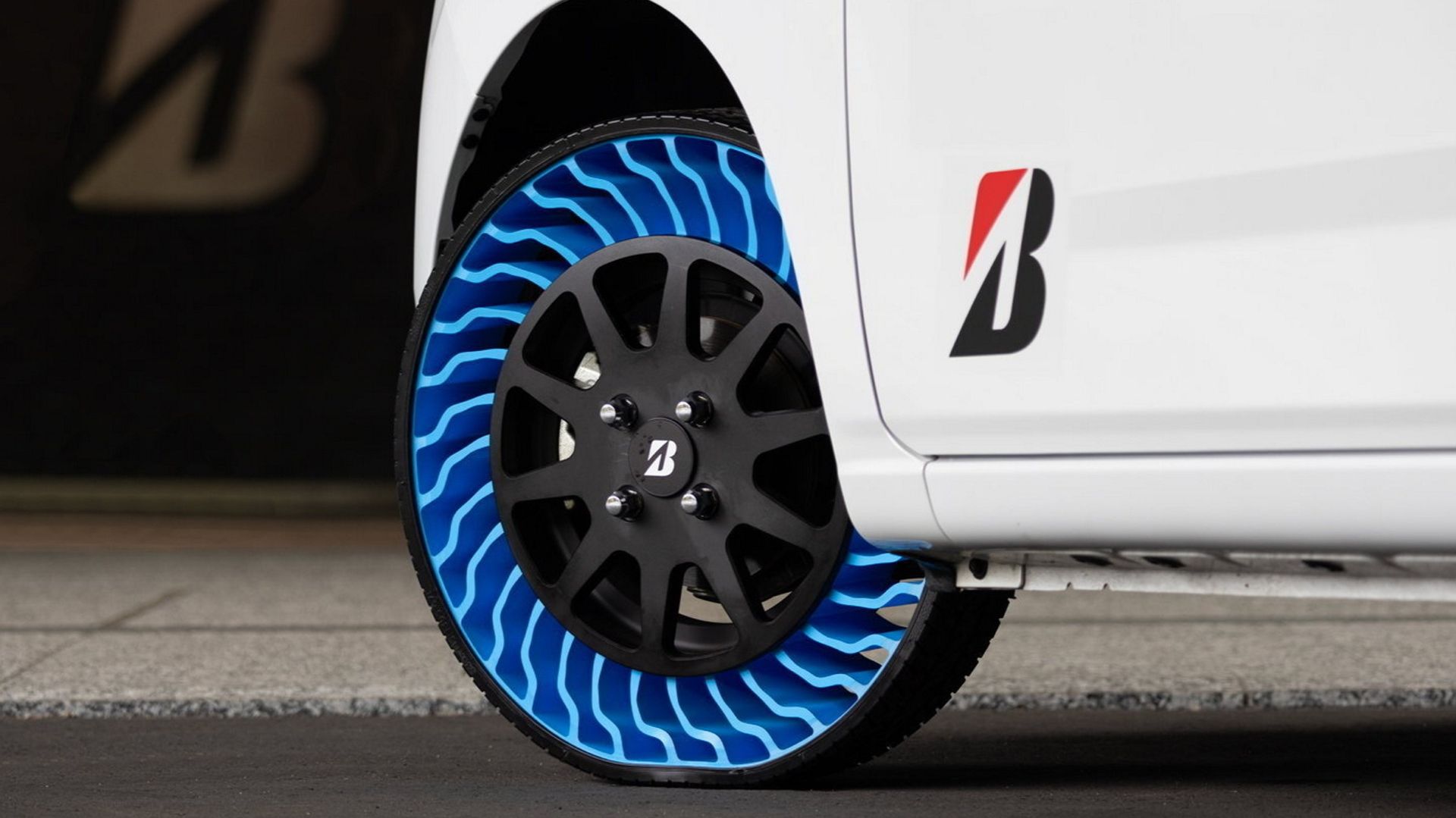
Car parts supplier Bridgestone is testing advances in tyres that never puncture, potentially smoothing the path for more self-driving vehicles.
The Japanese company, which vies with France’s Michelin to be the world’s largest tyre supplier, has developed an air-free version it says can support a 1-tonne vehicle driving at 60km an hour, a big advance over the capabilities of solid tyres a decade ago.
New computer-enabled structures and materials have led to significant innovations to improve their performance at higher speeds and weights, making them contenders to replace pneumatic tyres just as driverless vehicles are putting a premium on safety and no stoppages.
But pneumatic tyres’ huge performance and cost advantages make them extremely tough to dislodge.
The new tyres are being trialled on shuttle buses and tourist vehicles, as Japan seeks to bring autonomous driving to rural communities to address shortages of drivers and mechanics. The innovation is also seen as a potential differentiator amid rising Chinese and Indian competition.
“When we eventually get to autonomous driving, there’ll be big value in avoiding vehicles stopping deep in the mountains without a driver because of a burst tyre,” said Masaki Ota, manager of Bridgestone’s new mobility business development.
Computer simulations have helped to create tyres with a spoke structure encased in a rubber tread, with the spokes able to bounce and bend at higher speeds and weights without becoming a drag on fuel consumption, a smooth ride and safety compared with previous airless tyres.

The tyres could mean lower maintenance costs and reduced liability risk from autonomous driving accidents caused by punctures.
But experts fear the design, with production costs several times that of pumped tyres, could struggle to carve out a niche. Bridgestone has also inverted the usual logic of innovation, targeting low-performance vehicles for the mass market first, instead of testing the products in high-performance racing.
Replacing all pneumatic tyres with airless ones is “a utopia that will cost too much”, said Florent Menegaux, chief executive of Michelin. The company has worked on airless tyres for 20 years and had already put its own version, called Tweel, on smaller vehicles such as lawnmowers in the US.
“To go from a lawnmower to a car, to drive at 50km an hour, poses other problems,” he said. They include a whirring sound, the risk of stones flying out of the spokes and maintaining performance at high speeds and weights over time, said analysts.
Michelin has run trials of its puncture-proof, airless Uptis tyres on small vans for delivery groups DHL and La Poste, but the rubber and aluminium wheels remain in a prototype stage.
Menegaux said Michelin was “not ready from an industrial point of view” to take it further, despite the logistics groups being “very happy”.
Bridgestone hopes to gauge customer willingness to pay for air-free tyres through demonstrations, such as a six-seater self-driving car in a mountainous area of the city of Higashiomi in which more than half the 309 residents are elderly.
“We honestly haven’t yet reached a clear vision of how much this business will make and what sort of market it will be,” said Ota. “But we’re not waiting to find out.”
The incentive for the major incumbent tyremakers is compelling. Their business model is under threat from cheaper Chinese and Indian competition as tyres have become commoditised, and they are losing about 5 per cent per year of their total volume, according to Tire Industry Research, a specialist consultancy.
Instead, tyre suppliers want to expand in services. Customers would return regularly to retread air-free tyres — expected to last 10 years versus three to five for pneumatic tyres.
“I don’t know yet if they’re going to work in terms of delivering all the technical requirements of lifespan, fuel economy and price that the world needs,” said David Shaw, chief executive of Tire Industry Research.
But success was more likely than not, he added, because “pneumatic tyres are a pain”.