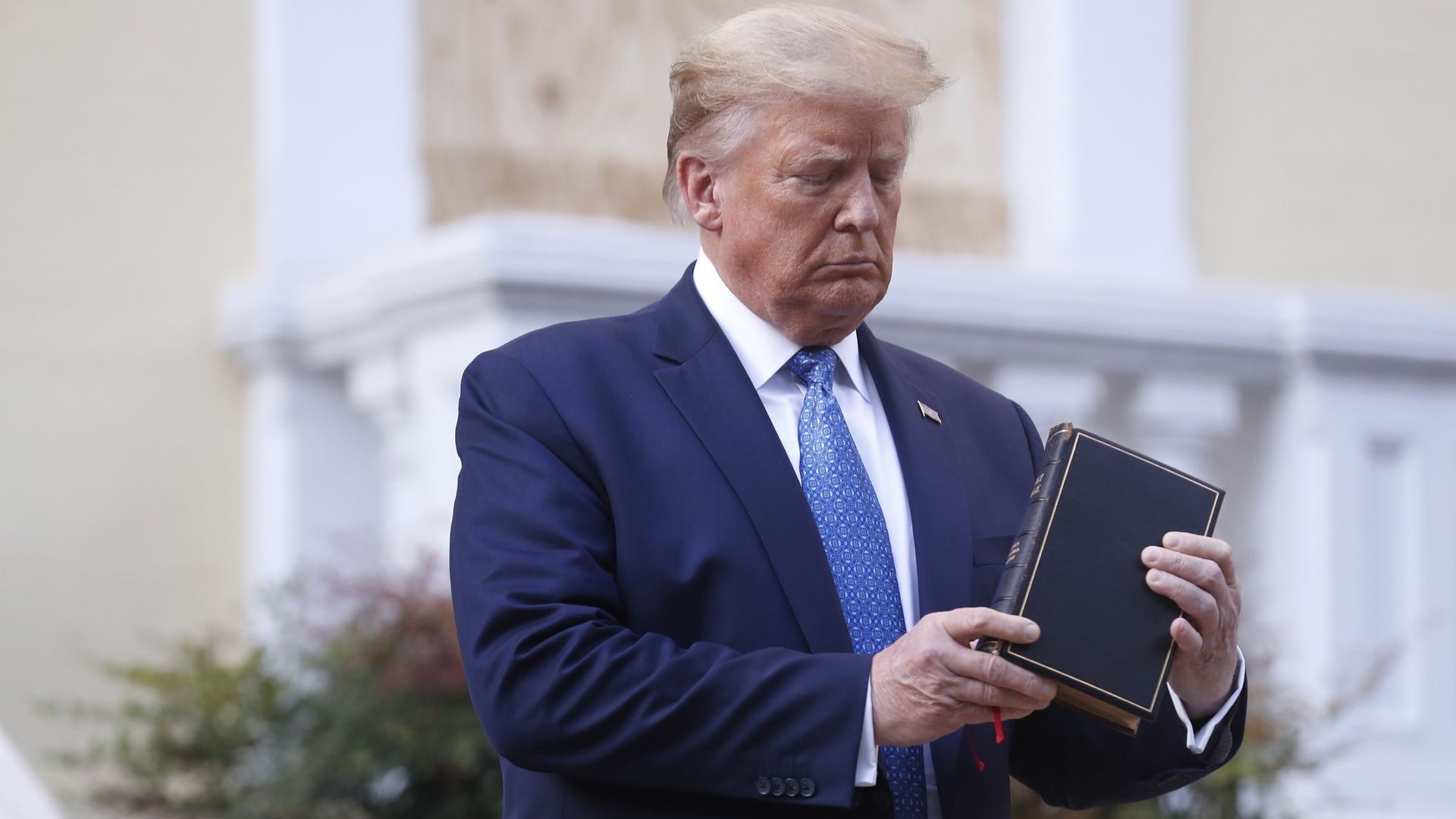
Next week, when Donald Trump strokes a Bible and requests the help of God as president, even a large share of his own fans will doubt that he means either gesture. Thirty-eight per cent of them, as well as most Americans in general, have him down as “not too” or “not at all” religious. I won’t presume to know the inner life of a stranger. But as far as the public is concerned, the US has had, and is about to have again, a leader who is at least atheist-adjacent. Within my lifetime, this was unthinkable.
It is worth pausing to mark little liberal wins, such as the creeping secularisation of the most important country on Earth. Seventy per cent of Americans were members of a place of worship as recently as the millennium. Now fewer than half are. The religious right, while still a force, as Dobbs showed, has to be more covert and euphemistic than it was under Reagan or either Bush. Trump keeps the agents of God around him, no doubt. But on what a tellingly short leash.
A liberal looking for some shards of light in the general murk doesn’t have to make do with this. Here is another intellectual victory so total and pervasive that it tends to pass without notice:
When was the last time someone suggested “de-growth”, and received a hearing? When did it last seem deep and clever to name “wellbeing” as something that should displace gross domestic product? Pre-Covid? Almost everyone in public life now has to pay at least lip service to economic growth: in Europe, which doesn’t have enough, in the US, which does and wants more, in India, which hopes to be a rich country by 2047.
Trump keeps the agents of God around him, no doubt. But on what a tellingly short leash
“It’s time we admitted there’s more to life than money,” said David Cameron, who grew up in a rectory, though which wing of it he favoured I don’t know. A prime minister who spoke that sentence in public now wouldn’t see out the week. There is nothing like economic stagnation to teach a country that anything you might rate above money — the preservation of nature, universal access to art, leisure time for relationships — itself depends on surplus income. GDP, while not everything, is almost everything. The priorities of liberal capitalism are harder to question than in the very recent past.
And even this isn’t the ultimate fillip for we who believe in that cause. Five winters ago, news of a viral pandemic started to trickle through. When the lockdown began, I thought it would be 2025 before tourism, nightlife and the ambient sound of cars would come back in full. Other people I thought I knew well hoped that it would be longer. There is a romantic and almost medieval distaste for modern life that simmers away in societies that have been rich for a long time. It isn’t confined to nature-is-healing airheads. It drove TE Lawrence to the desert, and enamoured George Kennan of pre-industrial Russia.
Well, it lost. My prediction was pessimistic by, what, three years? Tourism is rife. I can’t get a table at Goodbye Horses. New York has introduced a congestion charge. In the end, as soon as restrictions eased, people voted with their feet for liberal modernity, even if few of them would think to call it that.
One of the dangers of being excessively online is that you over-index small-time “trends”. Yes, quack science is spreading. This or that gasbag reactionary has two million followers. But these things have to be set against larger defeats for the superstitious, the nostalgic and the anti-modern: defeats so structural as to be hard to spot.
In retrospect, it was a deceptively civilised moment when Trump couldn’t name his favourite Bible verse during a TV interview. (“I don’t want to get into specifics.”) Thomas Jefferson had to go through brilliant circumlocutions to pass off his beliefs as something mistakable as Christian faith. It is possible that one or two recent presidents have slyly padded out whatever quantum of religious feeling dwelt inside them. Now? Going through the motions is enough. Like no other modern figure, Trump shows that liberalism is beleaguered, and quietly rampant.
Email Janan at janan.ganesh@ft.com
Find out about our latest stories first — follow FT Weekend on Instagram and X, and sign up to receive the FT Weekend newsletter every Saturday morning