The biggest story of our time is not the US presidential election or Elon Musk’s ego. It is our destruction of the natural world, which places into jeopardy our own future. Sadly, this story is depressing and overwhelming, and therefore not generally the stuff of bestsellers.
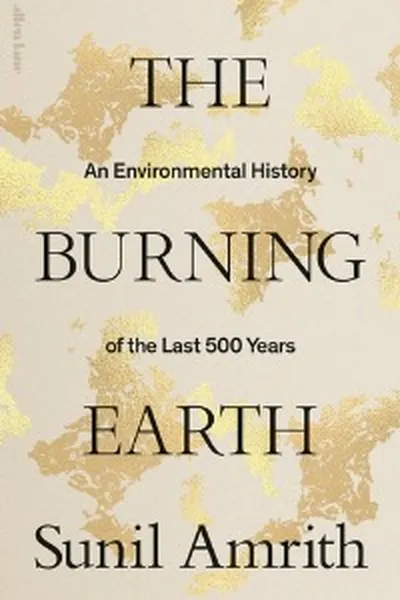
It is also, as Sunil Amrith reminds us in The Burning Earth, not a new story. His narrative begins in England in 1217. Two years after Magna Carta, the nobility secured a “Charter of the Forest” that would facilitate their exploitation of land, timber and game. For the rich, the freedom to influence laws went hand-in-hand with the freedom to plunder nature. So it has been ever since.
A professor of history at Yale University, Amrith recounts countless episodes of human greed, including the imperialism of Spain, Russia, China, Britain and others; the growth of South Africa’s gold mines, where the suffering of African miners helped to forge London as a financial centre; and the murders of modern-day environmentalists. We have reached planetary crisis because of “our inability to imagine kinship with other humans, let alone other species”. We failed to understand that freedom has “ecological preconditions”.
The Burning Earth is billed as a “paradigm-shifting global survey of how human history has reshaped the planet, and vice versa”. In truth, it covers some of the same ground as Oxford historian Peter Frankopan did in The Earth Transformed, published early last year. Only by understanding how we have treated the planet in the past can we understand our future, both books argue.
Amrith does place more emphasis on Asian history. He mentions his childhood in Singapore, whose long-serving prime minister Lee Kuan Yew called air conditioning “the most important invention for us”.
One of the book’s contentions is that, particularly after the advent of fossil fuels, humans wrongly believed that they could be free of nature’s constraints. This framing is intuitively appealing, but Amrith provides little evidence that this is how people thought. He simply states that, by 1900, colonial administrators believed “they had mastered nothing less than life itself”, even though millions died in famines in the 1890s, linked to the El Niño climate phenomenon. The Burning Earth goes on to quote a UN report from 1952 stating that “man can be the master of his environment and not its slave” (this was in the context of reducing infectious disease). But the book is mainly one episode of destruction after another, with only rare titbits about ideas.
Much of the activity he describes is not humans “escaping” nature, but treating it as a series of exploitable resources. This may have partly reflected people’s belief less in their own greatness than in their own powerlessness. Amrith quotes John Smith, the leader of Jamestown colony in Virginia in the early 17th century, who said of wild animals: “their bounds are so large, they so wilde, and we so weake and ignorant, we cannot much trouble them”.
The Burning Earth evokes some lesser-known episodes, including India’s sterilisation of 8mn people in 1976-77, arguably a more brutal approach to population control than China’s one-child policy. It mentions Albert Kahn, a Parisian banker who made a fortune investing in diamond and gold mines, and, before his death in 1940, commissioned a photographic archive of the Earth’s surface “while there is still time”. Even a rich, powerful man like Kahn could not save the natural world; he could only document it. Meanwhile, those following the recent US political row over “childless cat ladies” will smile at how one critic attacked the pioneering environmentalist Rachel Carson: “Why is a spinster with no children so concerned with genetics?”
Frankopan’s The Earth Transformed was over 700 pages; The Burning Earth is around 400 pages. Normally I would reach for the shorter book, but here what seems to have been cut is the analysis and nuance. The Burning Earth risks painting all societies as almost equally contemptuous of the poor, the natural world, and non-human animals. China’s Great Leap Forward — in which even the common sparrow was targeted for supposedly eating too much grain — is presented as just an extreme example of human greed.
The latter section deals with burgeoning environmental consciousness, which Amrith dates post-1970s. The “tragic” feature of environmental politics, he notes with elegance, is “how quickly we went from the stirring of awareness to despair that we might be too late”. He finds hope on university campuses and in young people’s climate strikes, evidence that people are finally standing up to “the self-destructive folly” of the past two centuries.
Voices against destruction have existed for centuries, and it’s a shame that Amrith does not seek to explain why they have generally been drowned out. Perhaps the answer is obvious: by definition, defenders of the environment could not marshal the resources that the purveyors of destruction invariably did. If so, are we destined simply to seek out new frontiers to exploit, whether the deep seabed or outer space, to satisfy our greed? Or might we finally turn our unmatched ingenuity to developing a different mode of human flourishing?
The answer depends, in part, on the influence of people like Donald Trump and Elon Musk. They are not the biggest story of our time, but they are episodes in it.
The Burning Earth: An Environmental History of the Last 500 Years by Sunil Amrith Allen Lane £30, 432 pages
Join our online book group on Facebook at FT Books Café and subscribe to our podcast Life and Art wherever you listen